
Technological advancements help drive improved patient outcomes, but in today’s NHS, financial constraints and operational challenges often create a divide between clinical ambition and reality.
To understand what is preventing or delaying implementation of innovative medical technologies, we conducted a poll asking NHS financial stakeholders to identify their top financial challenges. Here’s what they told us.
Data based on responses from 137 NHS financial decision-makers (Survey conducted by Ergéa UK in June-Dec 2025).
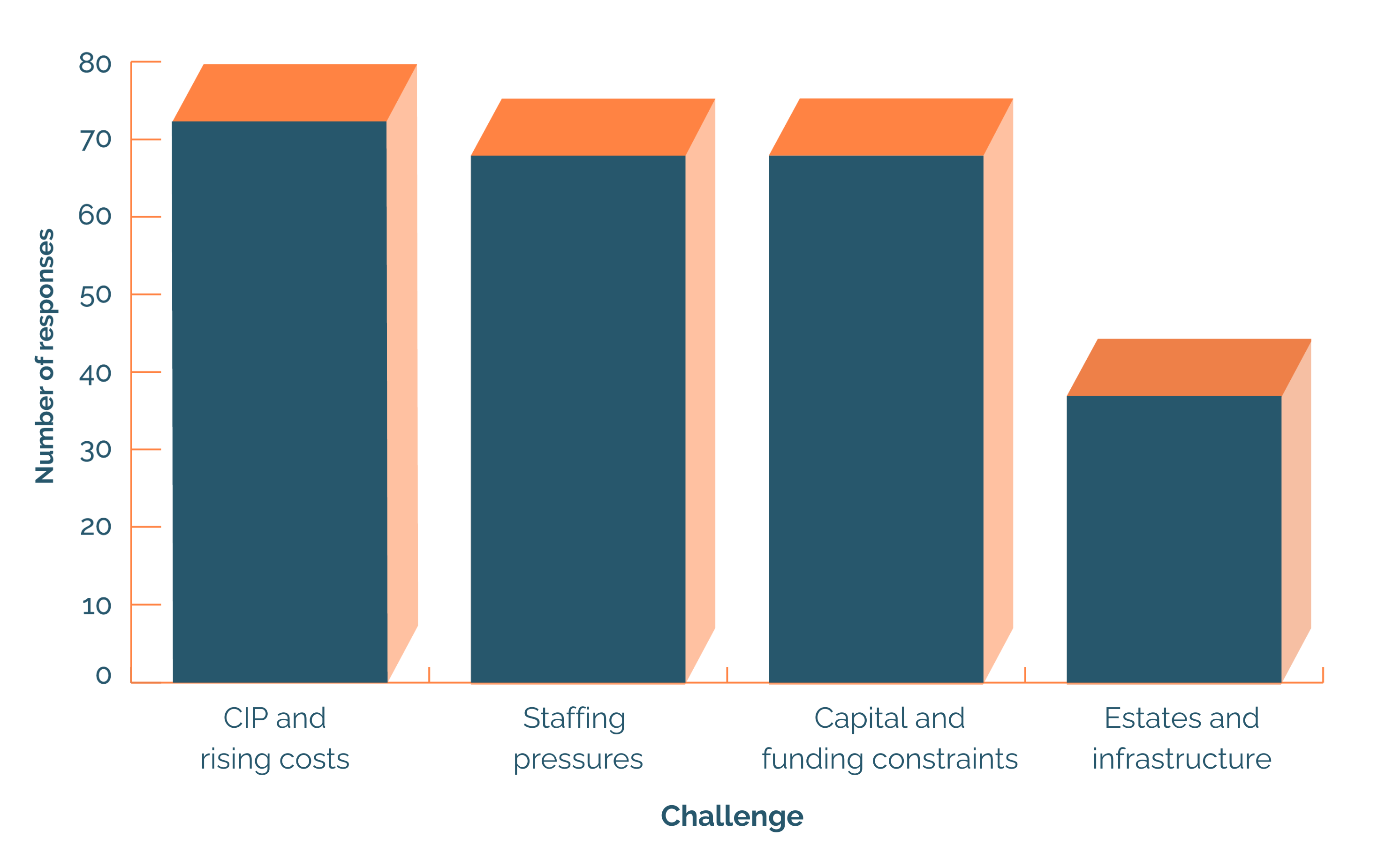
Are these financial pressures restricting improvements in patient care?

CIP and rising costs

Staffing Pressures

Capital and funding constraints

Estates and Infrastructure
How our flexible Managed Service solutions can help
At Ergéa UK, we work alongside NHS Trusts to tackle these challenges, combining clinical insight, technological expertise, a vendor-neutral approach, and strong buying power to deliver solutions that create clinical, financial, and operational value.
We offer clear long-term agreements and performance guarantees which can:
- Support CIP targets by identifying cost-savings, streamlining procurement, and reducing admin - freeing up resources for patient care
- Reduce unplanned expenditure and improve budget control through fixed-cost models and asset management
- Leverage strong buying power to secure cost-effective solutions and deliver greater value.
- Unlock operational savings through lifecycle planning, technology upgrades, and optimised maintenance
- Predictable, fixed costs that protect against price volatility
- Economies of scale through strong supplier relationships and consolidated procurement
- The ability to reinvest savings into innovation, service improvement and workforce support
We can help alleviate workforce cost pressures and improve staff retention by:
- Managing processes for equipment procurement, installations and maintenance to free up clinical and administrative time
- Reducing the existing workload with AI-enabled technologies
- Delivering advanced technologies which engage clinical staff, support professional development, and help to attract and retain talent.
We offer a self-funded model providing financial flexibility which enables:
- Access to the latest equipment without upfront capital outlay preserving cash reserves for other priorities
- Funding arrangements that spread costs over time and align payments with service delivery
- Breadth of services including enabling works, infrastructure upgrades, and technology refresh programmes under a single managed agreement
We offer a self-funding model that provides financial flexibility and enables infrastructure delivery under a Managed Service Contract, rather than a traditional capital build. This managed service includes the design, build, and provision of medical devices.
Key Benefits include:
- Delivery of infrastructure buildings, including CDCs through a Managed Service model avoiding the need for upfront capital expenditure - on time and budget
- Scope covering enabling works, infrastructure upgrades, and ongoing asset compliance and performance, reducing project risk and eliminating capital cost spikes
- No upfront payment, with flexible funding arrangements that spreads costs over the contract term
- Use of future-proofed infrastructure delivered through the Modern Methods of Construction